Diastasis recti is often talked about as a “core separation”—but it’s more than just a gap in your abs.
If you’ve noticed a bulge, doming, or persistent weakness in your core, it’s usually a sign your body isn’t managing pressure and load effectively.
At Breathe in Motion, we help active women and athletes in Brookfield and Mequon rebuild core strength, improve coordination, and return to movement with confidence.
What Is Diastasis Recti?
Diastasis recti is a separation of the rectus abdominis muscles (your “six-pack” muscles) along the midline of the abdomen.
This occurs at the linea alba, a connective tissue that:
- Supports the core
- Transfers force through the trunk
- Helps coordinate movement between the upper and lower body
While it’s most common during pregnancy and postpartum, it can also occur in:
- Athletes performing repetitive core loading
- Individuals who hold their breath during lifting
- People with poor pressure management during exercise
What Causes Diastasis Recti?
Diastasis recti develops when pressure inside the abdomen exceeds what the connective tissue can manage.
Common contributors include:
- Pregnancy and postpartum changes
- Hormonal shifts that affect tissue elasticity
- Improper core loading during exercise
- Chronic breath-holding or bearing down
- Poor coordination between the diaphragm, core, and pelvic floor
It’s not just about the tissue—it’s about how your system handles pressure.
Common Signs and Symptoms
Diastasis recti can present in different ways, including:
- A visible bulge or doming along the midline
- A “pooch” that doesn’t respond to traditional core exercises
- Decreased core strength or stability
- Low back pain or pelvic discomfort
- Difficulty controlling pressure during lifting or exercise
This isn’t just cosmetic—it affects how your body moves and performs.
Why Traditional Core Exercises Don’t Always Work
Many people try:
- Crunches
- Sit-ups
- Planks
…but symptoms persist or worsen.
Without addressing:
- Breathing
- Pressure management
- Core coordination
These exercises can increase strain instead of improving function.
How Physical Therapy Treats Diastasis Recti
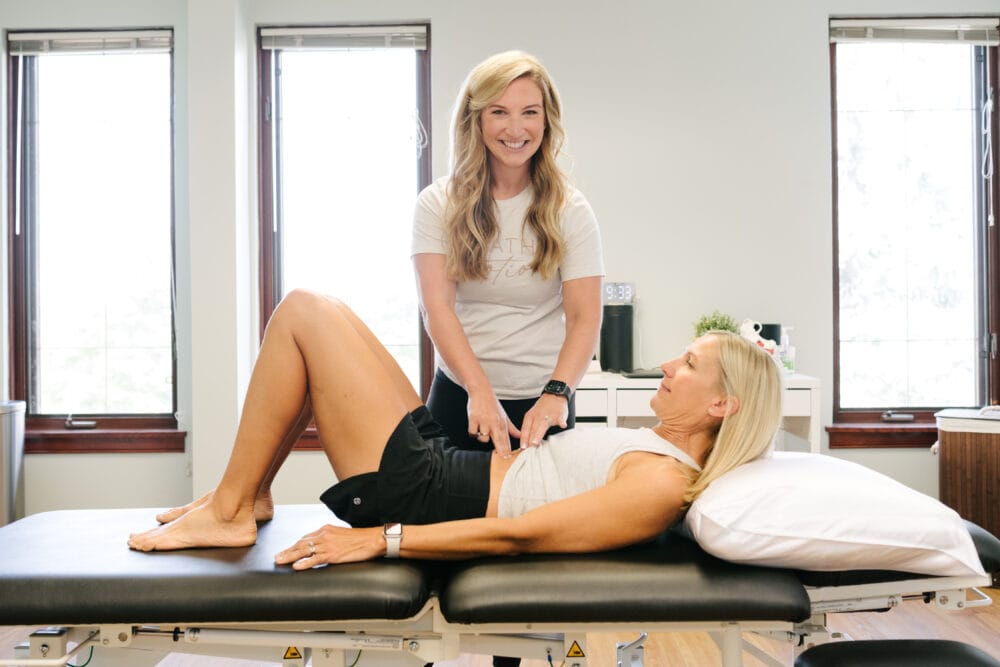
At Breathe in Motion, we focus on restoring how your core works—not just closing the gap.
1. Restore Core and Pelvic Floor Coordination
We retrain how your:
- Diaphragm
- Deep core (transverse abdominis)
- Pelvic floor
…work together as a system.
2. Improve Pressure Management
You’ll learn how to:
- Breathe effectively
- Brace without bearing down
- Manage load during movement
3. Build Strength That Transfers to Real Life
We progress from:
- Foundational core work
→ to - Functional strength training
→ to - Lifting, running, and higher-level activity
4. Modify Movement and Exercise
We adjust:
- Lifting mechanics
- Exercise selection
- Daily movement patterns
So your core can handle load without compensation.
5. Return to Activity with Confidence
Whether your goal is:
- Lifting
- Running
- Returning postpartum
- General fitness
We guide a structured progression that supports long-term strength.
Can Diastasis Recti Improve Without Surgery?
In many cases, yes.
Physical therapy can:
- Improve core strength and tension
- Reduce symptoms
- Restore function and performance
The focus isn’t just on closing the gap—it’s on how your body functions.
When to See a Physical Therapist
It’s time to get evaluated if you notice:
- Persistent doming or bulging
- Core weakness that isn’t improving
- Pain with lifting or exercise
- Difficulty returning to workouts postpartum
It’s never too early—or too late—to address it.
The Goal: A Strong, Functional Core
Diastasis recti doesn’t mean your core is “broken.”
It means your system needs better coordination and support.
When your core, breath, and pelvic floor work together, you can:
- Move with confidence
- Train without fear
- Build strength that lasts
Ready to Rebuild Your Core Safely?
If you’re dealing with core weakness, doming, or discomfort, this is exactly what we assess during a full evaluation.
Serving active women and athletes in Brookfield, Mequon, and the greater Milwaukee area.
Book your pelvic floor physical therapy session at Breathe in Motion and get a plan built for your body, your goals, and your lifestyle.